

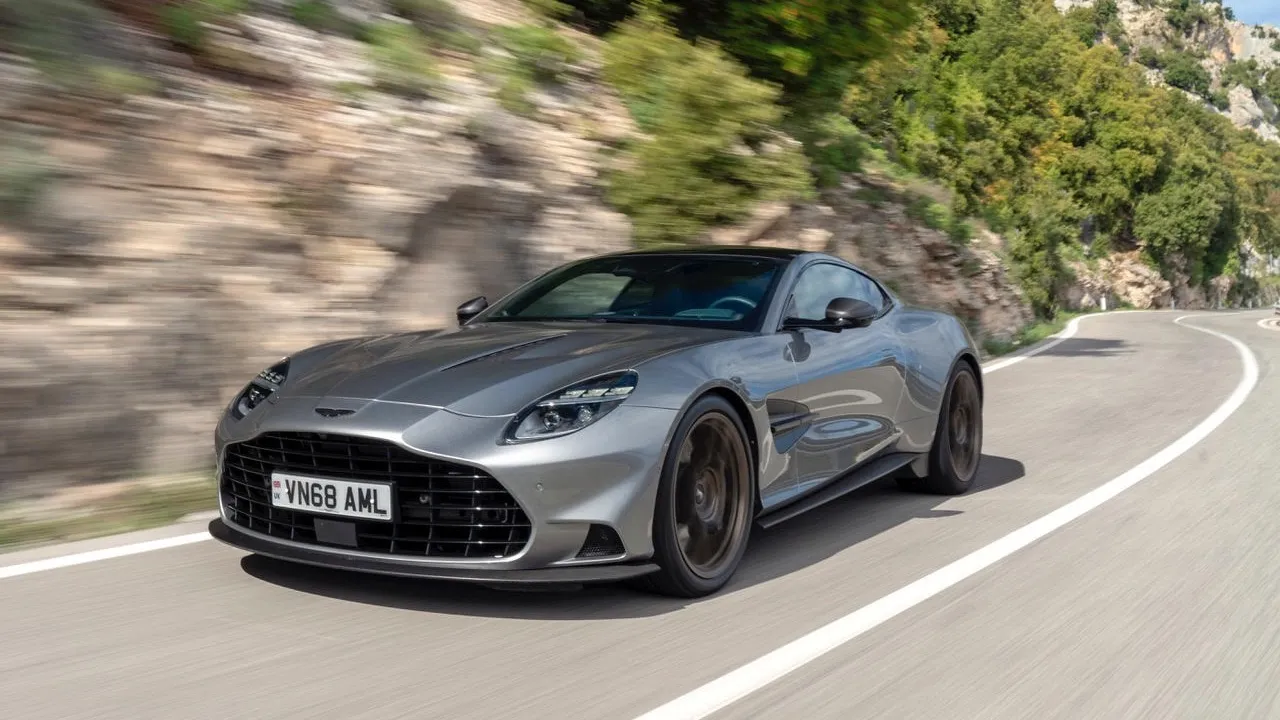
Summary
Aston Martin One-77: The 750 HP Cosworth V12 Supercar That Became the Ultimate Aston Martin
In the late 2000s, legendary British automaker Aston Martin took an unexpected direction while planning what it would later call the brand’s definitive sports car.
For decades, Aston Martin had relied on some of the finest engines in the automotive world, including its iconic six-liter V12 engine. However, during the development of its ultimate performance machine, the company decided not to simply reuse that powerplant.
Instead, Aston Martin partnered with renowned British engine manufacturer Cosworth to transform its existing V12 into a completely bespoke masterpiece.
The goal was ambitious:
- Produce at least 700 horsepower.
- Reduce engine weight by 10% compared with the original six-liter V12.
- Create an engine worthy of Aston Martin’s most exclusive sports car.
The result was the legendary Aston Martin One-77, a machine that many consider one of the greatest Aston Martins ever built.
It also introduced the largest-capacity V12 engine ever installed in a production car.
Aston Martin Goes Bigger Than Ever With the One-77
A Supercar Designed Without Compromise
On March 3, 2009, Aston Martin unveiled the One-77 concept at the Geneva Auto Show.
The reaction was immediate.
Spectators were stunned, competitors were eager to study the details, and the automotive world quickly realized that Aston Martin had created something unlike anything else in its lineup.
The company had not cut corners anywhere during development.
The One-77 combined advanced technology with traditional craftsmanship, including hand-formed aluminum body panels created by Aston Martin’s skilled artisans.
For the chassis, Aston Martin looked toward the German Touring Car (DTM) Championship for inspiration.
The result was a lightweight carbon fiber monocoque chassis based on the principles used by front-engine, rear-wheel-drive racing cars.
Motorsport-Inspired Suspension Technology
Taking more inspiration from racing, the One-77 featured a genuine performance-focused suspension setup.
Each corner received a double wishbone suspension system, providing the type of handling capability expected from a track-focused machine.
However, the centerpiece of the entire project was the engine.
Aston Martin developed an enlarged version of its famous V12 engine in collaboration with Cosworth, creating a naturally aspirated powerplant designed to deliver at least 700 horsepower while weighing significantly less than the original unit.
What Aston Martin engineers did not expect was just how far Cosworth could push the legendary V12 platform.
Cosworth Creates One of the Greatest V12 Engines Ever Built
A Partnership Between Two British Engineering Icons
When it comes to building high-performance engines, Cosworth is considered one of the most respected names in automotive history.
Founded in 1958, the company has produced some of the world’s most famous engines, including:
- The Ford BDA engine.
- Multiple Formula One engines, including V10 powerplants.
- IndyCar and Champ Car engines.
- The legendary Mercedes-Benz 190E 2.3-16 engine.
With such an impressive history, it was only natural that Aston Martin turned to Cosworth for the One-77 project.
The Foundation: Aston Martin’s Six-Liter V12
The original Aston Martin V12 was already a remarkable engine.
It began development in 1994, during the period when Ford owned Aston Martin. With access to Ford’s engineering resources, Aston Martin designed the engine with endurance racing ambitions, including the possibility of competing in the 24 Hours of Le Mans.
A major part of the design philosophy was producing large amounts of torque at low engine speeds.
The all-aluminum AML V12 first ran in 1995 and eventually found its way into the Aston Martin DB7.
Over the years, the engine received multiple upgrades and remained a cornerstone of Aston Martin’s lineup for decades.
The 7.3-Liter Cosworth V12 Becomes a Record-Breaking Engine
Engineering Changes That Transformed the V12
For the One-77 project, Cosworth dramatically redesigned the AML V12.
The engine displacement increased to:
7,312 cc
That represented roughly 1.3 liters more than the original engine.
Cosworth also introduced several major improvements, including:
- A dry-sump lubrication system.
- Lower engine placement.
- Improved weight distribution.
- A revised front-mid-engine layout.
The dry-sump system allowed the engine to sit approximately four inches lower than any previous Aston Martin V12, lowering the vehicle’s center of gravity.
The engine was also moved around 10 inches farther back from the front wheel centerline, placing it closer to the cabin and improving balance.
The Numbers Were Incredible
The finished engine became the largest-capacity V12 ever installed in a production vehicle.
Specifications included:
- 7.3-liter naturally aspirated V12
- 750 horsepower
- 553 lb-ft of torque
- 11,000 rpm redline
It was an engineering achievement unlike anything Aston Martin had produced before.
Aston Martin One-77 Becomes a Modern Legend
Performance Beyond the Numbers
The One-77 delivered exactly what Aston Martin promised: a definitive sports car.
Performance figures included:
- Top speed exceeding 220 mph.
- 0-60 mph acceleration in approximately 3.5 seconds.
However, the real magic was not just the numbers.
The engine’s responsiveness and flexibility made the One-77 an extraordinary driving experience.
Power was delivered through a six-speed automated manual transmission (AMT) sending power to the rear wheels.
A slight press of the accelerator could unleash acceleration that felt more like a fighter jet launching from an aircraft carrier than a traditional grand tourer.
Advanced Suspension Made the One-77 Even More Special
The One-77 featured a fully adjustable suspension system with advanced motorsport technology.
It was the first road car to use Dynamic Spool Valve (DSSV) technology, a system commonly associated with racing applications.
Interestingly, the modern Ford Mustang GTD uses similar technology more than 15 years later.
Another unique feature was Aston Martin’s customer-specific suspension setup.
When each One-77 was delivered, Aston Martin engineers adjusted the suspension according to the owner’s preferences.
Owners could request settings optimized for:
- Nürburgring track driving.
- High-speed touring.
- Comfortable road use.
The One-77 Was Not Perfect
Despite being one of Aston Martin’s greatest creations, the One-77 had one major weakness.
The single-clutch automated manual transaxle transmission received criticism for its slow and rough operation.
A modern dual-clutch transmission would likely have improved acceleration and reduced the 0-60 mph time closer to three seconds.
Aside from the gearbox, however, the One-77 remains widely regarded as an exceptional machine.
Only 77 Aston Martin One-77 Models Were Built
Exclusivity was a major part of the One-77’s appeal.
As the name suggests, Aston Martin produced only:
77 examples worldwide
Because of its rarity, finding one for sale is extremely difficult.
A well-maintained example can command prices of around:
$4 million
That makes ownership unrealistic for most enthusiasts, but the One-77 remains a dream car for collectors and automotive historians.
Other Legendary High-Capacity V12 Engines
Lister Storm
The Lister Storm was another rare British performance car powered by a massive V12 engine.
Created by Lister Cars, the Storm was essentially a road-legal version of a Le Mans racing machine.
Its construction featured:
- Aluminum honeycomb monocoque chassis.
- Kevlar and aluminum body panels.
- Jaguar-derived seven-liter V12 engine.
The engine was based on the powerplant used in the Jaguar XJR-9 Le Mans racing prototype.
The V12 was positioned in a mid-front layout, allowing for a unique 2+2 seating configuration.
However, only four road-legal examples were ever produced.
One major reason was its price: approximately $350,000 in 1993, when a Ferrari Testarossa 512 TR cost about half as much.
Aston Martin and Cosworth Continue Their V12 Legacy With Valkyrie
The partnership between Aston Martin and Cosworth continued years later with the incredible Aston Martin Valkyrie.
Introduced in 2021, the Valkyrie was developed with input from Formula One engineering legend Adrian Newey, who envisioned it as a road-going Formula One car.
Cosworth created a completely new V12 engine known as the RA.
Its specifications include:
- 6.5-liter naturally aspirated V12
- 1,001 horsepower at 10,500 rpm
- 546 lb-ft of torque
It became the most powerful naturally aspirated engine ever fitted to a road-legal vehicle.
Aston Martin then added an electric motor to the front differential, increasing total system output to:
1,160 horsepower
The Aston Martin One-77 Remains an Automotive Masterpiece
The Aston Martin One-77 represents a rare moment when an automaker pushed engineering boundaries without compromise.
Its massive Cosworth-developed V12, carbon fiber chassis, handcrafted bodywork, and limited production numbers turned it into one of the most remarkable supercars of the modern era.
While newer models may offer more technology and faster acceleration, few vehicles can match the character, exclusivity, and mechanical drama of the One-77.