

Summary
Google’s new Home Speaker is a somewhat puzzling product.
It arrives nearly six years after the impressive Nest Audio, right in the middle of Google’s aggressive Gemini expansion and shortly after the debut of Gemini for Home, the company’s AI-powered smart home assistant. What’s even more surprising is that Google first quietly revealed the device nearly nine months ago. That raises an obvious question: why did it take so long to release such a straightforward smart speaker? And why reuse the exact same name as the original Google Home speaker introduced in 2016?
After spending the past week using the new Home Speaker as my primary speaker for music playback and smart home control—including managing a wide range of Google Home-compatible smart lights—I’ve come to one conclusion. While the speaker delivers solid audio performance, Google’s decision to place Gemini for Home’s most compelling features behind a subscription paywall feels difficult to justify.
A More Modern Design With Slightly Weaker Sound Than the Nest Audio
Still a Significant Upgrade Over the Nest Mini
The new Google Home Speaker replaces both the $100 Nest Audio and the compact $50 Nest Mini, simplifying Google’s smart speaker lineup to just the new Home Speaker, the 2nd-Gen Nest Hub, and the Nest Hub Max.
If you’re upgrading from the Nest Mini, the improvement is substantial. Thanks to its 58mm driver—compared to the Nest Mini’s 40mm driver—the new speaker produces noticeably deeper bass and a fuller overall sound.
However, when compared to the Nest Audio, equipped with its 75mm woofer and dedicated 19mm tweeter, the new Home Speaker represents a noticeable downgrade in audio quality.
The Nest Audio has never competed directly with premium smart speakers like the older Sonos One, but for its $100 price, it consistently delivered a surprisingly spacious soundstage that exceeded expectations.
That doesn’t mean the new Google Home Speaker sounds bad. Quite the opposite. Music comes through its compact, fabric-covered enclosure with impressive clarity, whether you’re listening to guitar-driven tracks like Brand New’s “Sic Transit Gloria… Glory Fades” or bass-heavy songs such as Mac Miller’s “The Spins.”
Still, anyone expecting a meaningful sound quality upgrade over the Nest Audio is likely to be disappointed. The older speaker continues to outperform the new model, particularly in bass response.
Compared to the Nest Mini, however, the improvement is undeniable—which is exactly what you’d expect from a speaker that costs $50 more than Google’s 2019 entry-level smart speaker.
Google’s New Design Is Easily Its Biggest Strength
From a design perspective, Google got almost everything right.
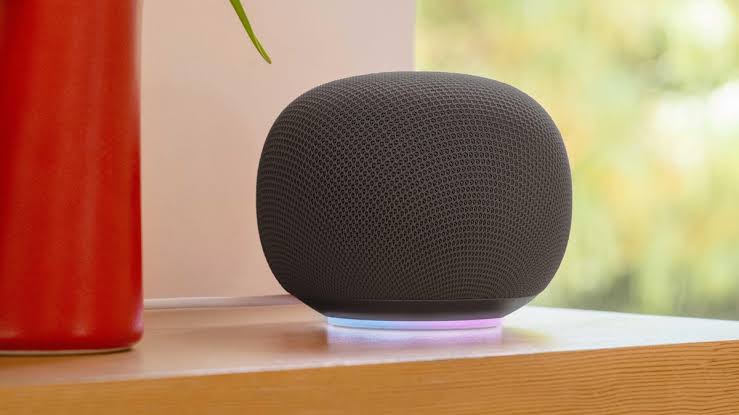
The Home Speaker adopts a clean, spherical shape that feels considerably more refined than both the Nest Audio and Nest Mini. It also stands out against competing smart speakers, including Amazon’s latest Echo and even Apple’s HomePod mini.
Whether you choose the Porcelain finish or the Hazel color featured here, the speaker looks elegant enough to blend naturally into almost any room.
A subtle light ring illuminates beneath the speaker whenever you interact with it, reminiscent of older Amazon Echo devices. While it’s simpler than the four-light system found on the Nest Audio and Nest Mini, I actually prefer this cleaner approach.
Touch controls are located on the top surface and respond quickly. Tapping either side adjusts the volume, while pressing the center pauses or resumes playback. That said, I found myself relying on voice commands for most interactions.
Gemini’s Best Features Are Locked Behind a Subscription
After the Six-Month Trial, Gemini Live Costs $10 Per Month
Voice controls are where Google’s new Home Speaker becomes both more interesting and more frustrating.
After spending time with Gemini for Home, I unexpectedly found myself missing certain aspects of Google Assistant.
Google now separates smart home functionality into two subscription tiers: the Premium Standard plan at $10 per month ($100 annually) and the Premium Advanced plan at $20 per month ($200 annually). Purchasing a new Google Home Speaker includes six months of access at no additional cost.
The Premium Standard subscription includes doorbell and camera history—something I personally don’t find valuable because I already use a Ring Smart Doorbell.
More importantly, however, it unlocks Gemini Live, Google’s conversational AI mode that has already been available on newer Pixel devices for several years.
To me, Gemini Live represents the primary reason Gemini for Home exists in the first place. That’s why it’s surprising to see Google placing such a core feature behind a recurring subscription.
After testing Gemini Live, I found the experience generally impressive. Conversations feel natural, although more complicated, multi-step questions can occasionally confuse the assistant. There were also a few situations where conversations unexpectedly stopped without explanation.
When everything works correctly, though, Gemini Live genuinely feels like the next evolution of smart home interaction.
It’s also disappointing that more advanced capabilities—such as creating Automations through natural language—are included only with the Premium Standard subscription.
Being able to casually tell the assistant to close your blinds at a certain time is genuinely convenient.
Fortunately, users can still build those routines manually, but the entire purpose of Gemini for Home is to simplify that process through conversational AI rather than manual configuration.
Without the Subscription, It Feels Like a Nest Audio With Better Looks
Users who choose not to subscribe still retain access to essential voice commands such as playing music, setting timers, and performing the same everyday tasks that Google Home speakers have handled for years.
The problem is that, without Gemini Live, the new Google Home Speaker essentially becomes a slightly weaker-sounding Nest Audio wrapped in a much more attractive spherical design.
Adding to that, Gemini for Home already supports Google’s existing smart speakers, while Gemini Live itself isn’t compatible with the original Google Home or the original Google Home Mini.
If your home already includes several Nest Audio speakers and a couple of 2nd-Gen Nest Hubs—as mine does—you can already experience Google’s updated AI assistant without purchasing this new speaker.
The only noticeable advantage I’ve found is that the new Home Speaker responds a little faster when handling more complex Gemini requests.
It’s Hard to Identify the Ideal Buyer
Although I’m genuinely impressed by the new Google Home Speaker’s modern design and don’t mind the slight compromise in sound quality compared to the Nest Audio, it’s difficult to recommend at its $100 price.
Once the complimentary six-month trial expires, users also need to consider the additional $10 monthly subscription if they want access to Gemini Live and several of the speaker’s most appealing AI-powered capabilities.
For anyone who already owns a Gemini for Home and Gemini Live-compatible smart speaker, the value proposition becomes even less convincing.
If Google removed the subscription requirement, the new Google Home Speaker would immediately become a far more compelling smart speaker.
One additional feature worth mentioning is its ability to function as an external speaker for the Google TV Streamer. Although I haven’t personally tested this capability, reports suggest that it performs quite well.