

Summary
Few American automobiles carry the same level of recognition and national pride as the Ford Mustang. Introduced in 1964, the Mustang quickly became one of the best-selling vehicles of the decade and was so influential that it created an entirely new automotive segment known as the pony car. Its popularity remained strong throughout the 1960s and well into the 1970s, and decades later, the Mustang continues to enjoy a loyal global following.
During the late 1980s, however, Ford considered taking the iconic model in a completely different direction. As Japanese-inspired sports coupes continued gaining popularity, the company explored the idea of replacing the Mustang with an entirely new vehicle—the Ford Probe.
Borrowing its name from a series of Ford concept cars introduced throughout the 1970s and 1980s, the Probe was designed to reflect changing market trends. Although the car achieved respectable commercial success, it ultimately failed to accomplish its original mission.
A Modern Successor That Mustang Fans Never Wanted
When the Ford Probe debuted for the 1989 model year, many Mustang enthusiasts strongly opposed Ford’s long-term plan. Despite changing consumer preferences, the Mustang remained one of America’s most recognizable performance cars. While sales no longer matched the extraordinary success of its early years, its popularity remained strong enough that many buyers simply couldn’t imagine replacing it.
The public reaction made one thing clear—few people wanted the Mustang to disappear.
The Probe itself was developed through Ford’s close partnership with Mazda, a relationship that included shared manufacturing and significant corporate investment.
Rather than building another large-displacement American performance coupe, Ford and Mazda collaborated on a smaller, more refined sports coupe inspired by the growing success of Japanese competitors.
The result was the Ford Probe, introduced at a time when Japanese sports cars were rapidly reshaping the performance coupe market.
First-Generation Ford Probe (1989–1992)
Ford’s answer to the growing popularity of Japanese sports coupes
The first-generation Ford Probe arrived in late 1988 as a 1989 model with an ambitious mission. Beyond serving as Ford’s potential Mustang replacement, it was expected to compete directly against popular Japanese models such as the Honda Prelude, Mitsubishi Eclipse, and Acura Integra.
Since many of those competitors were already well established, Ford faced an uphill battle from the very beginning.
The 1989 Probe launched with a suggested retail price of approximately $11,250, which equals roughly $29,380 today. That pricing made it more than $2,000 less expensive than the Nissan 240SX and nearly $3,000 cheaper than the entry-level Honda Prelude.
Its American manufacturing helped keep costs competitive, while its sleek styling—created by Ford designer Toshi Saito—gave it an appearance that blended naturally alongside Japanese rivals.
Built on Mazda’s GD platform, which was also shared with vehicles like the Mazda MX-6, the first-generation Probe was available in three trim levels.
The entry-level GL offered only basic equipment, including manual windows and no air conditioning.
Stepping up to the LX added several convenience features, including power windows and power mirrors.
At the top of the lineup sat the Probe GT, equipped with a turbocharged four-cylinder engine, four-wheel disc brakes, a three-way adjustable suspension system, and variable power steering. Mazda also handled much of the suspension tuning for the GT model.
Engine options
Ford offered three engine choices throughout the first generation:
- A naturally aspirated 2.2-liter inline-four served as the standard engine.
- A turbocharged 2.2-liter inline-four, available exclusively in the GT.
- A 3.0-liter Vulcan V6, introduced midway through the 1990 model year.
Buyers could pair these engines with either a five-speed manual or a four-speed automatic transmission, both supplied by Mazda.
After three model years, Ford introduced a completely redesigned second generation.
Overall, the first-generation Probe sold approximately 390,000 units, exceeding Ford’s expectations and proving commercially successful despite public skepticism.
Second-Generation Ford Probe (1993–1997)
A smoother design inspired by the 1990s sports coupe trend
By the early 1990s, the sharp, angular styling that defined many 1980s vehicles had largely disappeared. Automakers increasingly embraced smoother, more aerodynamic shapes, and the second-generation Probe reflected that transition perfectly.
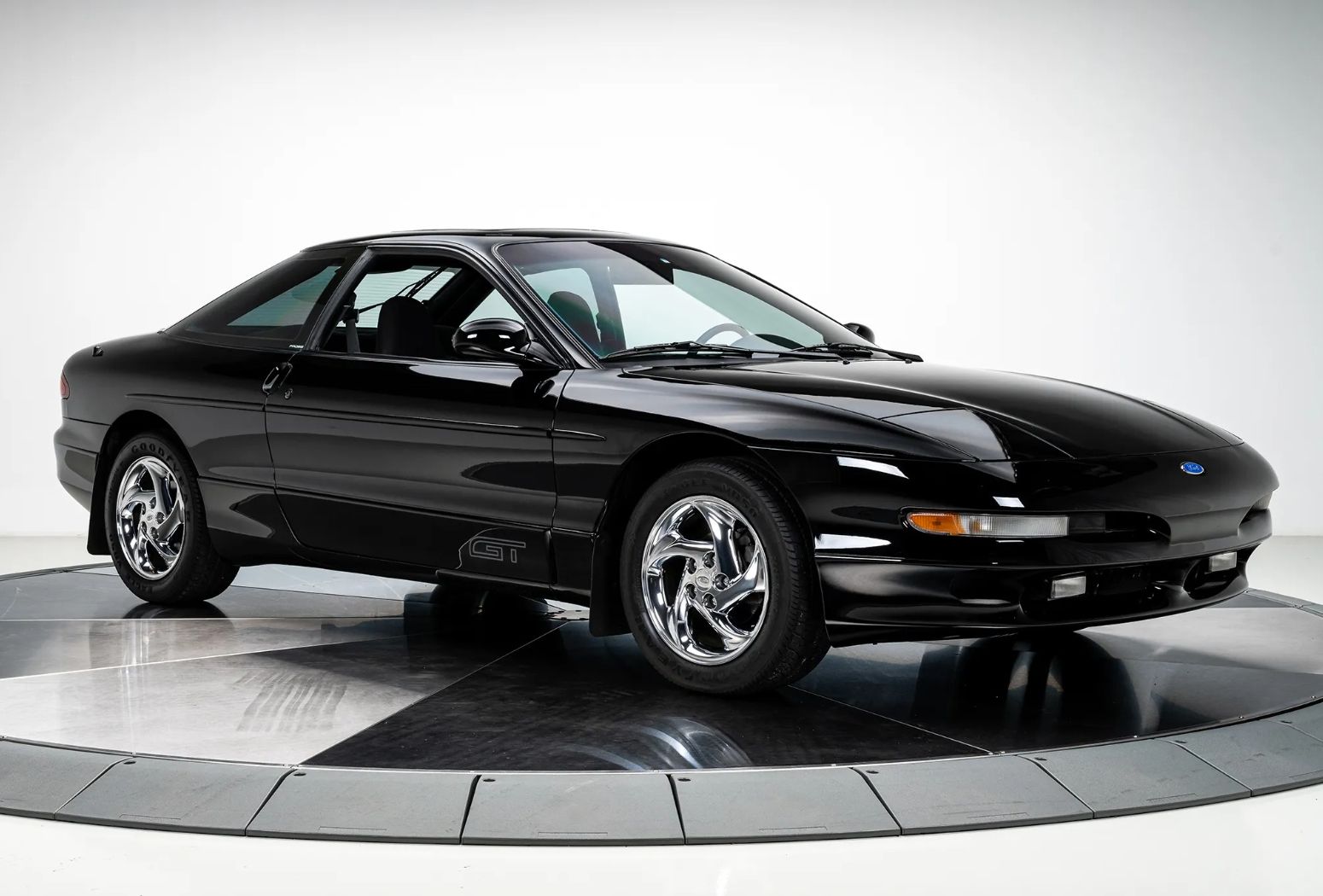
The redesigned model became longer, wider, lower, and significantly more rounded, adopting styling cues similar to contemporary Japanese sports cars like the second-generation Mazda RX-7 and fourth-generation Toyota Supra.
Ford handled both the exterior and interior design, while Mazda remained responsible for the vehicle’s underlying mechanical platform.
The new Probe entered the market at the end of 1992 as a 1993 model, carrying a starting price of $12,845, which equals roughly $28,800 today.
Despite its larger dimensions, the second-generation Probe weighed approximately 125 pounds less than its predecessor, largely because Ford increased the use of lightweight plastic body components.
Designed with everyday usability in mind
Lead designer Mimi Vandermolen approached the second-generation Probe with accessibility as a key priority.
She famously explained:
“If I can solve all the problems inherent in operating a vehicle for a woman, that’ll make it that much easier for a man to use.”
Her goal was to create a sports coupe that combined ease of use with an enjoyable driving experience.
The second-generation Probe adopted Mazda’s GE platform, replacing the earlier GD architecture.
Unlike the original model, the new Probe launched with only two primary trim levels.
The base model featured a naturally aspirated 2.0-liter four-cylinder engine.
The GT remained the flagship variant, powered by a naturally aspirated 2.5-liter V6.
Ford briefly expanded the lineup in 1995 with the introduction of the SE (Sport Edition).
The SE received unique wheels and a GT-inspired front fascia while retaining the standard 2.0-liter engine. However, the trim lasted only through the 1996 model year before being discontinued.
Transmission choices included two different four-speed automatic gearboxes and a five-speed manual transmission.
A Commercial Success That Never Replaced the Mustang
Although it became obvious almost immediately that the Probe would never be accepted as the Mustang’s successor, Ford’s decision to continue producing the model proved financially worthwhile.
The first generation exceeded internal sales expectations, while the second generation also performed well commercially, although it wasn’t quite as successful.
Between 1993 and 1997, Ford sold approximately 310,000 second-generation Probes.
However, the arrival of the completely redesigned 1994 Ford Mustang dramatically changed the market.
As enthusiasm for the new Mustang grew, Probe sales began falling rapidly.
Faced with declining demand, Ford decided against developing a third generation, ending production after the 1997 model year.
The Ford Probe’s Legacy
The Ford Probe began life as a controversial project built around an ambitious—but ultimately flawed—strategy. Designed to capitalize on the growing popularity of Japanese sports coupes while positioning itself as the Mustang’s eventual replacement, it never achieved that original objective.
Even so, the Probe carved out its own place in Ford’s history. Despite the criticism surrounding its purpose, it became a commercially successful sports coupe that proved there was room for a different kind of performance car in Ford’s lineup—even if it was never destined to replace an American icon like the Mustang.