

Summary
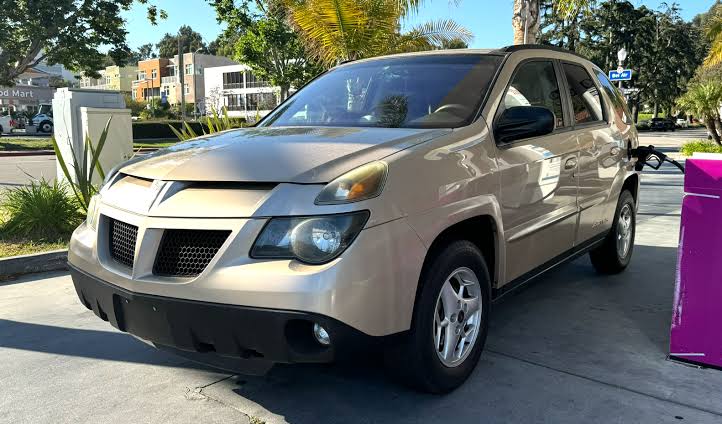
The Pontiac Aztek is one of the most recognizable vehicles ever built, thanks to its unconventional styling and its memorable appearance in Breaking Bad. While its design divided opinion from the start, the Aztek was an ambitious attempt to create a new kind of crossover aimed at younger, adventure-focused drivers.
Although the concept looked promising on paper, it failed to achieve commercial success. Production lasted just five model years before Pontiac discontinued the vehicle.
Looking back today, however, it’s easy to see that the Aztek wasn’t necessarily a bad idea—it was simply ahead of its time. Many of the features and accessories that once seemed unusual have since become common in today’s SUVs and crossovers.
The Pontiac Aztek: A Crossover With a Built-In Tent
A Lifestyle Vehicle Before the Trend Took Off
The Pontiac Aztek was unlike anything Pontiac had produced before.
First unveiled at the 1999 North American International Auto Show in Detroit, the Aztek shared its platform with the Pontiac Montana minivan. Despite that shared foundation, it introduced a completely different concept.
Its styling blended SUV and passenger car elements, combining rugged plastic body cladding with a mix of sharp edges and rounded curves. While that design may seem familiar today, it was highly unconventional at the turn of the millennium, long before crossovers dominated the market.
Mechanically, the Aztek kept things straightforward. It came with a single 3.4-liter V6 engine producing 185 horsepower and 210 lb-ft of torque, paired with a four-speed automatic transmission. Buyers could choose between front-wheel drive or the optional Versatrak all-wheel-drive system.
Camping Features That Were Ahead of Their Time
Accessories Designed for Everyday Use and Weekend Adventures
One of the Aztek’s most distinctive qualities was its extensive lineup of optional accessories.
Pontiac positioned the Aztek as a true lifestyle vehicle—practical enough for daily commuting while also serving as a capable companion for camping trips and outdoor adventures.
Among its most innovative features was a removable front center console that doubled as a portable cooler, allowing drivers to keep drinks and snacks chilled while traveling.
The available camping package pushed the concept even further.
It included:
- A built-in tent that attached directly to the rear hatch
- An inflatable air mattress
- A setup that transformed the crossover into a compact camper
Rather than creating a dedicated off-road SUV, Pontiac focused on building a versatile vehicle capable of handling occasional adventures while remaining practical for everyday driving.
Other optional convenience features included:
- A sliding cargo floor
- Built-in grocery storage compartments
- Rear cargo-area stereo controls
Today, these ideas feel surprisingly familiar, proving that Pontiac’s vision may simply have arrived before consumers were ready for it.
How Porsche, Volkswagen, and Rivian Reinforced the Aztek’s Vision
Modern Automakers Have Embraced Similar Concepts
Although the Aztek struggled commercially, its focus on lifestyle accessories anticipated a trend that has become increasingly popular.
One notable example comes from Porsche, which now offers a premium rooftop tent compatible with models including the 911 Carrera, Panamera, Taycan, and Cayenne.
The two-person tent features:
- Waterproof construction
- Weather-resistant materials
- A built-in mattress
- An insect screen
- A compact folding design for storage
Outside the United States, Volkswagen has taken a similar approach with the T7 Multivan.
Its optional Good Night Package transforms the van into a compact camper by adding:
- A fold-out bed
- Blackout window shades
- Ventilation grilles
- Optional folding chairs and a table
Another example came from Rivian, which originally planned to launch its Camp Kitchen for the R1T pickup.
Designed to slide out from the truck’s Gear Tunnel, the original concept included:
- A sink
- A stove
- A kettle
- A drying rack
Although production challenges prevented the full Camp Kitchen from reaching customers, Rivian later introduced the simplified Travel Kitchen, a portable cooking system priced at $1,400 instead of the originally planned $5,000 package.
These examples demonstrate how the Aztek’s focus on outdoor versatility eventually became a mainstream automotive trend.
Buying a Pontiac Aztek Today
A Rare Crossover With Growing Appeal
Finding a Pontiac Aztek on today’s used market isn’t always easy.
During its production run, Pontiac sold 119,694 units, with annual sales never surpassing 30,000 vehicles.
More than twenty years after production ended, surviving examples—particularly low-mileage vehicles in good condition—have become increasingly uncommon.
Current prices generally range from approximately:
- $5,000 for older or higher-mileage examples
- Up to $12,000 for cleaner, lower-mileage vehicles in better condition
Reliability Improved Throughout Production
Later Models Delivered Better Long-Term Performance
Overall, the Aztek proved to be reasonably reliable, although early production years experienced several issues.
According to NHTSA records:
- The 2001 model received 231 complaints and six recalls, with many involving the fuel system and airbags.
- The 2002 Aztek saw complaints decline to 130, along with three recalls.
- The 2003 version recorded 141 complaints and four recalls.
Reliability improved significantly during the final years of production.
- The 2004 Aztek generated just 67 complaints and four recalls.
- The 2005 model performed best, with only 34 complaints and one recall.
Across the vehicle’s production run, the most commonly reported issues involved:
- Electrical systems
- Fuel system components
- Airbags
- Interior equipment
Why the Pontiac Aztek Failed
Styling, Timing, and Market Readiness Worked Against It
Several factors contributed to the Aztek’s disappointing sales performance.
Its bold exterior styling was unlike anything else available at the time, and many buyers simply weren’t ready to embrace such an unconventional design. While modern consumers have become accustomed to experimental styling—particularly with the rise of EVs—automotive design was far more conservative when the Aztek debuted.
Early reliability concerns also damaged public confidence. Although later model years proved much more dependable, the vehicle’s reputation had already been affected.
Perhaps the biggest challenge, however, was timing.
Pontiac targeted Generation X, promoting the Aztek as both an everyday family vehicle and a capable camping companion.
Today, multifunctional crossovers dominate the market, but at the beginning of the 2000s, the idea of a single vehicle serving multiple roles had yet to gain widespread acceptance.
The Aztek attempted to combine commuter practicality with outdoor adventure before buyers fully embraced that type of versatility.
Final Thoughts
The Pontiac Aztek remains one of the automotive industry’s clearest examples of a vehicle arriving before its time.
While its unconventional styling and early reliability concerns limited its commercial success, many of its defining ideas have become standard features in today’s crossover and SUV market.
Camping accessories, modular cargo systems, and adventure-focused equipment are now offered by manufacturers ranging from Porsche and Volkswagen to Rivian.
Had the Aztek been introduced several years later, it might have enjoyed a very different reception. Instead, it stands as a unique chapter in Pontiac’s history and an early pioneer of the modern lifestyle crossover.