

Summary
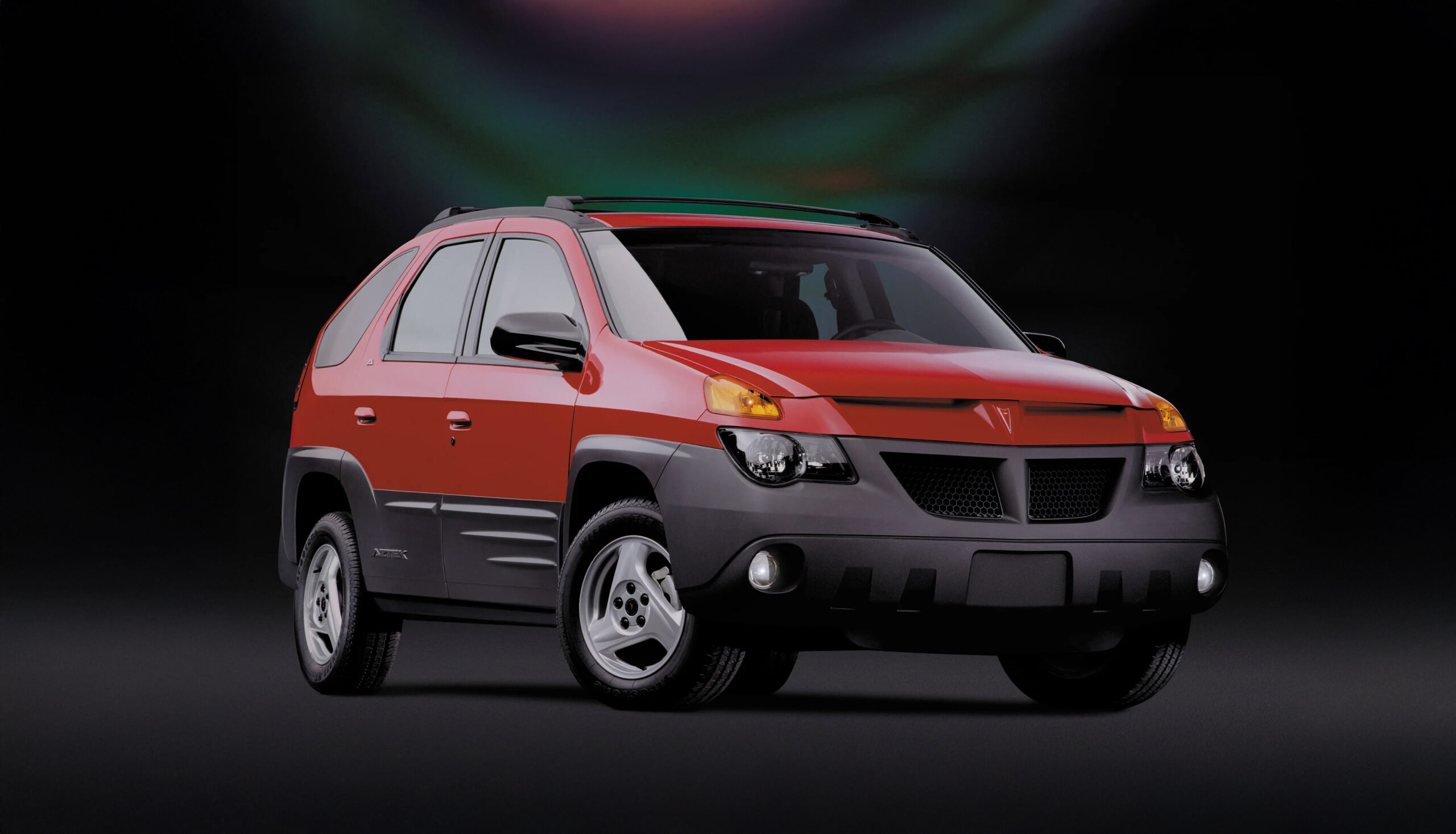
The Pontiac Aztek is one of those vehicles that’s impossible to ignore. Whether remembered for its unconventional styling or its memorable appearance in Breaking Bad, the Aztek has earned a lasting place in automotive history.
Originally designed as an early crossover aimed at younger buyers with active lifestyles, the Aztek introduced a range of innovative accessories that encouraged camping and outdoor adventures. Despite its ambitious concept, the model struggled to find commercial success and remained on the market for only five model years before being discontinued.
Looking back today, however, it’s easy to argue that the Aztek wasn’t a bad idea—it simply arrived before the market was ready. Many of the features that once made it seem unusual have since become common across today’s SUVs and crossovers.
The Pontiac Aztek Introduced the Lifestyle Crossover Before It Was Popular
An SUV That Came Equipped With a Built-In Tent
The Pontiac Aztek was unlike anything the brand had produced before.
It made its public debut at the 1999 North American International Auto Show in Detroit and was built on the same platform as the Pontiac Montana minivan. Even so, the Aztek stood apart with a design that blended elements of passenger cars and SUVs.
Its distinctive styling combined bold plastic body cladding, sharp edges, and sweeping curves to create a rugged yet unconventional appearance.
While that formula seems familiar today, crossover vehicles were still a relatively new concept at the beginning of the 2000s.
Under the hood, the Aztek kept things simple.
It was powered exclusively by a 3.4-liter V6 producing 185 horsepower and 210 lb-ft of torque, paired with a four-speed automatic transmission. Buyers could choose between front-wheel drive or the optional Versatrak all-wheel-drive system.
Camping Features That Were Years Ahead of the Competition
Practical Accessories Designed for Adventure
One of the Aztek’s most distinctive qualities was its collection of lifestyle-oriented accessories.
Pontiac envisioned the Aztek as a practical daily driver during the week and a capable camping companion on weekends. To support that concept, the company offered several optional features focused on outdoor living.
Among the most notable options was a removable center console that doubled as a portable cooler, allowing drivers to keep food and drinks chilled while traveling.
The available camping package took things even further.
It included:
- A custom tent that attached directly to the rear hatch
- An inflatable air mattress
- A setup that transformed the Aztek into a compact camper
Rather than creating a dedicated off-road vehicle, Pontiac aimed to deliver a versatile crossover capable of handling occasional outdoor adventures while remaining practical for everyday use.
Additional convenience features included:
- A sliding cargo floor
- Built-in grocery storage compartments
- Rear cargo-area stereo controls
At the time, these ideas seemed unconventional. Today, many of them have become standard concepts in the adventure vehicle segment.
Modern Automakers Have Adopted Similar Ideas
Porsche, Volkswagen, and Rivian Followed a Similar Path
Although the Aztek never became a sales success, many of its core ideas have resurfaced in today’s automotive market.
One example comes from Porsche, which now offers a premium rooftop tent compatible with models including the 911 Carrera, Panamera, Taycan, and Cayenne.
Designed for two occupants, the tent features:
- Waterproof construction
- Weather-resistant materials
- An integrated mattress
- Built-in insect protection
- A compact folding design for storage
Volkswagen has also embraced outdoor-focused accessories.
Its T7 Multivan offers the Good Night Package, which converts the vehicle into a camper using:
- A foldable bed
- Blackout window shades
- Ventilation grilles
- Optional folding table and chairs
Meanwhile, Rivian explored a similar concept with its ambitious Camp Kitchen.
Originally designed to slide out from the R1T’s Gear Tunnel, the kitchen was planned to include:
- A sink
- A stove
- A kettle
- A drying rack
Although the original design never reached production due to manufacturing challenges, Rivian later introduced the simplified Travel Kitchen, a portable cooking system priced at $1,400 instead of the originally planned $5,000 package.
These examples illustrate how the Aztek’s lifestyle-focused philosophy has become increasingly common among modern vehicle manufacturers.
Finding a Pontiac Aztek Today
A Rare SUV That Has Become Increasingly Collectible
Anyone interested in owning a Pontiac Aztek today may find the search challenging.
During its production run, Pontiac sold 119,694 units, with annual sales never exceeding 30,000 vehicles.
More than two decades after production ended, surviving examples—especially well-maintained, low-mileage models—have become increasingly difficult to find.
Current market prices generally range from:
- Around $5,000 for higher-mileage or rough-condition examples
- Up to approximately $12,000 for cleaner, lower-mileage vehicles
Reliability Improved Significantly Over Time
Later Model Years Proved Much More Dependable
Overall, the Aztek developed into a fairly reliable vehicle, although early production years experienced several notable issues.
According to NHTSA records:
- The 2001 Aztek received 231 complaints and six recalls, with many involving the fuel system and airbags.
- The 2002 model saw complaints fall to 130, along with three recalls.
- The 2003 version recorded 141 complaints and four recalls.
Reliability improved considerably during the final years of production.
- The 2004 model generated just 67 complaints and four recalls.
- The 2005 Aztek performed best, with only 34 complaints and one recall.
Across all model years, the most frequently reported issues involved:
- Electrical systems
- Fuel system components
- Airbags
- Interior equipment
Why the Pontiac Aztek Failed
Timing Was Just as Important as Styling
Several factors contributed to the Aztek’s disappointing commercial performance.
Its unconventional exterior design divided opinions at a time when automotive styling remained relatively conservative. Modern consumers have become far more accustomed to bold vehicle designs—particularly with the rise of electric vehicles—but that wasn’t the case when the Aztek debuted.
Early reliability concerns also damaged the vehicle’s reputation before later improvements could change public perception.
Perhaps the biggest obstacle, however, was timing.
Pontiac marketed the Aztek toward Generation X, attempting to combine everyday practicality with weekend camping capability in a single vehicle.
Today’s buyers readily embrace versatile crossovers capable of multiple roles, but at the beginning of the 2000s, that concept was still unfamiliar.
The market simply wasn’t ready for a “Swiss Army knife” vehicle that blurred the lines between family transportation and outdoor adventure.
Final Thoughts
The Pontiac Aztek remains one of the automotive industry’s most fascinating examples of a vehicle arriving before its time.
While its styling and early reliability challenges prevented it from becoming a commercial success, many of its defining ideas have since become mainstream across the SUV and crossover market.
Features like integrated camping accessories, modular cargo solutions, and adventure-focused equipment are now offered by manufacturers ranging from Porsche to Rivian.
Although the Aztek never achieved the recognition Pontiac had hoped for, its legacy lives on as an innovative crossover that anticipated many of today’s most popular automotive trends.