

Summary
When Nintendo unveiled the Switch 2, one of the most exciting announcements was its use of a custom Nvidia SoC built on Ampere architecture, featuring support for DLSS.
The promise was clear: smoother performance and sharper visuals using Nvidia’s AI-powered upscaling. But now that the console and its DLSS-enabled games are here, one thing is evident—DLSS on Switch 2 isn’t the same DLSS we know on PC.
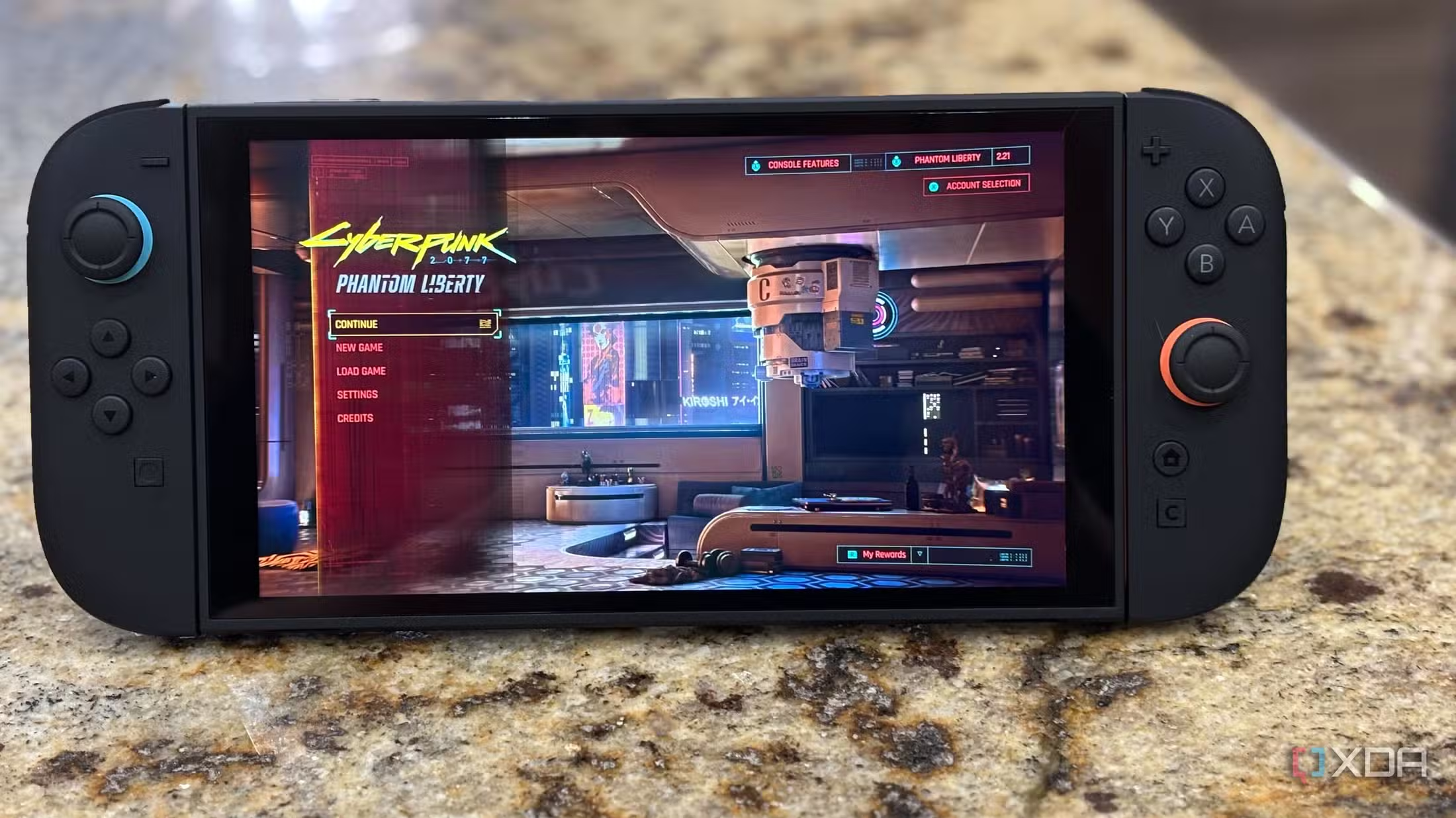
From the varying visual quality across games like Fast Fusion and Cyberpunk 2077, to noticeable compromises in image sharpness, it’s clear Nintendo’s console uses a stripped-down, highly optimized version of DLSS—what the community is calling DLSS Lite.
And while that may sound like a downgrade, this new approach could have big implications for future low-end PC gaming and mobile GPUs.
DLSS on Switch 2 Is Not DLSS on PC
The implementation of DLSS on the Switch 2 has drawn attention from Digital Foundry and the wider graphics community for its inconsistent results.
Some titles look good enough, while others appear soft, smeared, or blurry, even compared to PC games using DLSS at ultra performance mode.
This led to speculation—and now broad consensus—that Nintendo’s new console is running a custom, lightweight variant of DLSS.
While Nvidia hasn’t officially confirmed which model it’s using, performance analysis of titles like Fast Fusion suggest this is a simplified neural network, optimized for performance over image precision.
Why DLSS Has Overhead — And Why It Matters on Consoles
DLSS isn’t just a fancy upscaling filter.
Unlike traditional spatial upscaling methods (like FSR 1), DLSS runs on a neural network embedded inside your GPU, specifically using Tensor Cores.
This gives it the ability to reconstruct sharper images by analyzing motion vectors and temporal data, but it comes at a cost—computational overhead.
On powerful desktop GPUs like the RTX 3080 or even a 3060, this overhead is negligible.
But on constrained hardware like the Switch 2, that overhead becomes a critical bottleneck.
DLSS can sometimes consume more resources than it saves, unless it’s trimmed down into a more efficient (albeit lower-quality) version—hence DLSS Lite.
DLSS Lite: Built for Efficiency, Not Beauty
DLSS Lite appears to be a simplified AI model with lower resolution inputs, fewer layers, or a reduced precision pipeline.
It’s designed to run within the thermal and power constraints of a handheld hybrid console, trading some visual fidelity for real-time performance that would otherwise be impossible.
Here’s what we can infer about DLSS Lite:
-
It still uses AI (unlike FSR), but likely a pruned-down version of the core model.
-
It’s capable of outperforming FSR in similar conditions, but falls short of full DLSS in clarity and detail.
-
It could theoretically be adapted for low-end PCs, tablets, or handheld PCs like the Steam Deck and ROG Ally.
The Challenge of Scaling DLSS in the Future
Nvidia has been aggressively evolving DLSS. With DLSS 4, the company introduced transformer-based models that actually outperform native resolution rendering in some cases—but at the cost of higher VRAM and compute demands.
For example:
-
DLSS 4 requires nearly double the VRAM of previous versions.
-
The CNN-based models in earlier DLSS versions were lighter, but also less accurate.
-
TechPowerUp’s tests show that DLSS 4’s transformer model can reduce framerates compared to earlier versions on the same GPU.
If this trend continues, it’s not hard to imagine a future where even mid-range GPUs like the RTX 4060 may struggle to run the full version of DLSS, especially at high resolutions or with frame generation enabled.
Why DLSS Lite Could Be the Answer for Entry-Level PCs
DLSS Lite on the Switch 2 offers a blueprint for how Nvidia might make AI upscaling accessible to low-end systems in the future:
-
A scaled-down AI model that retains some of DLSS’s sharpness advantages
-
Lower VRAM and Tensor Core utilization
-
Viable performance boosts even on older or mobile hardware
In fact, the rumored Nvidia N1X SoC—a future entry-level or mobile chip—could potentially use this same DLSS Lite approach, making games more playable on thin-and-light laptops, budget GPUs, or integrated graphics systems.
DLSS Lite Is More Than a Compromise — It’s a Sign of What’s to Come
While DLSS Lite might look like a visual downgrade compared to what PC gamers are used to, it’s actually a strategically significant evolution of Nvidia’s upscaling tech.
It shows that DLSS can be adapted to run on power-constrained, low-performance hardware, and still provide meaningful gains over native rendering or older upscaling tools.
For developers and gamers alike, this raises an exciting possibility: DLSS for everyone.
From handhelds to Chromebooks, entry-level desktops to cloud gaming rigs, the future of DLSS might not just be about photorealism—it might be about scalability.
And if Nvidia plays its cards right, DLSS Lite might soon become a household name—not as a step down, but as a crucial bridge to democratize high-performance gaming.